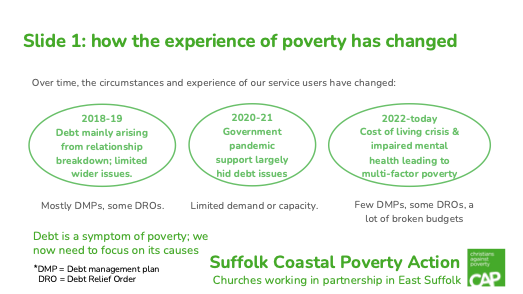
When the Suffolk Coastal Debt Centre (SCDC) was founded in 2018, working with clients to alleviate their debt was enough to set them on the path to wellbeing. Progressively, over the last eight years, the characteristics of our service users have changed and the majority now exhibit a number of causes of poverty which compound to make helping them out of poverty a much more challenging task. We have adapted to meet this more complex environment by providing a number of other services and activities not directly related to debt.
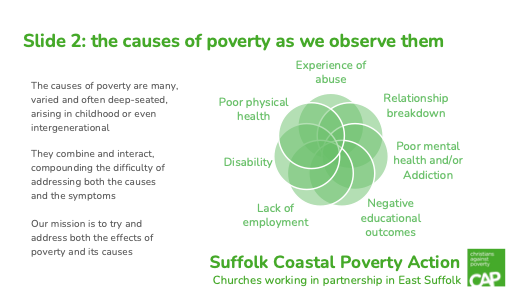
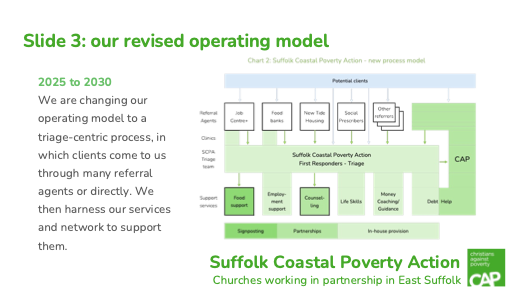
Our revised strategy, our new name – Suffolk Coastal Poverty Action (SCPA) – and our changed organisational structure not only reflect this change but put us on a pathway to evolve into a much broader anti-poverty charity by 2030. Rather than dealing primarily with debt, a symptom of poverty, we now seek to help people overcome the compound causes of poverty as well as its effects, hopefully leading to a greater sense of wellbeing. Some of these causes are very intractable and some (not necessarily the same ones) require dedicated technical expertise that we are unlikely to be able to provide. However, by effective triage we aim to understand and support service users holistically and we are augmenting our range of support accordingly. We are also improving our ability to signpost more effectively to partner organisations which have the necessary competencies to help those in need.
For more about the changes in the experience that we have observed and our new operating model to address current needs, please watch this video.
It has been over 18 months since we finalised our Strategy for 2030. During that time, we have:
- Recruited a Debt Help specialist, Simon, to lead that key service;
- Freed Laura, as a consequence, to focus on the holistic service offering and referrer management (as well as increasing Laura’s weekly hours);
- Recruited an Employment Support specialist, Rebecca, to launch and run our employment stream, with three full courses by the end of 2026;
- We have implemented a comprehensive triage application (called Restore) enabling our staff and volunteers (retrained for the purpose) to understand every service user’s poverty journey and current issues in a structured way;
- We have secured funding for our Counselling network (working with trained and qualified Counsellors) to support service users who are experiencing significant mental health issues;
- We have strengthened our relationships with referrers not only by Laura’s increased ability to interact with them but by the holistic range of services that we are now able to offer to those in poverty distress.
Our next challenge, which we are embarking on in early 2027, is to implement a structured CRM (Client Relationship Management) system to provide a secure framework for our case management process as we walk alongside our service users providing the range of services that each specifically needs in their circumstances.
Further potential service offerings are being evaluated for 2027.